
JC Cookware Highlights Full-Process Manufacturing Standards and Quality Safeguards in Stainless Steel Production
JIANGMEN, GUANGDONG, CHINA, August 6, 2026 /EINPresswire.com/ -- Jiangmen Xinhui Jincui Metalware Co., Ltd. (operating

Press Release Disclaimer: This is a press release distributed through the XPR Media network. It has not been independently verified by our newsroom.
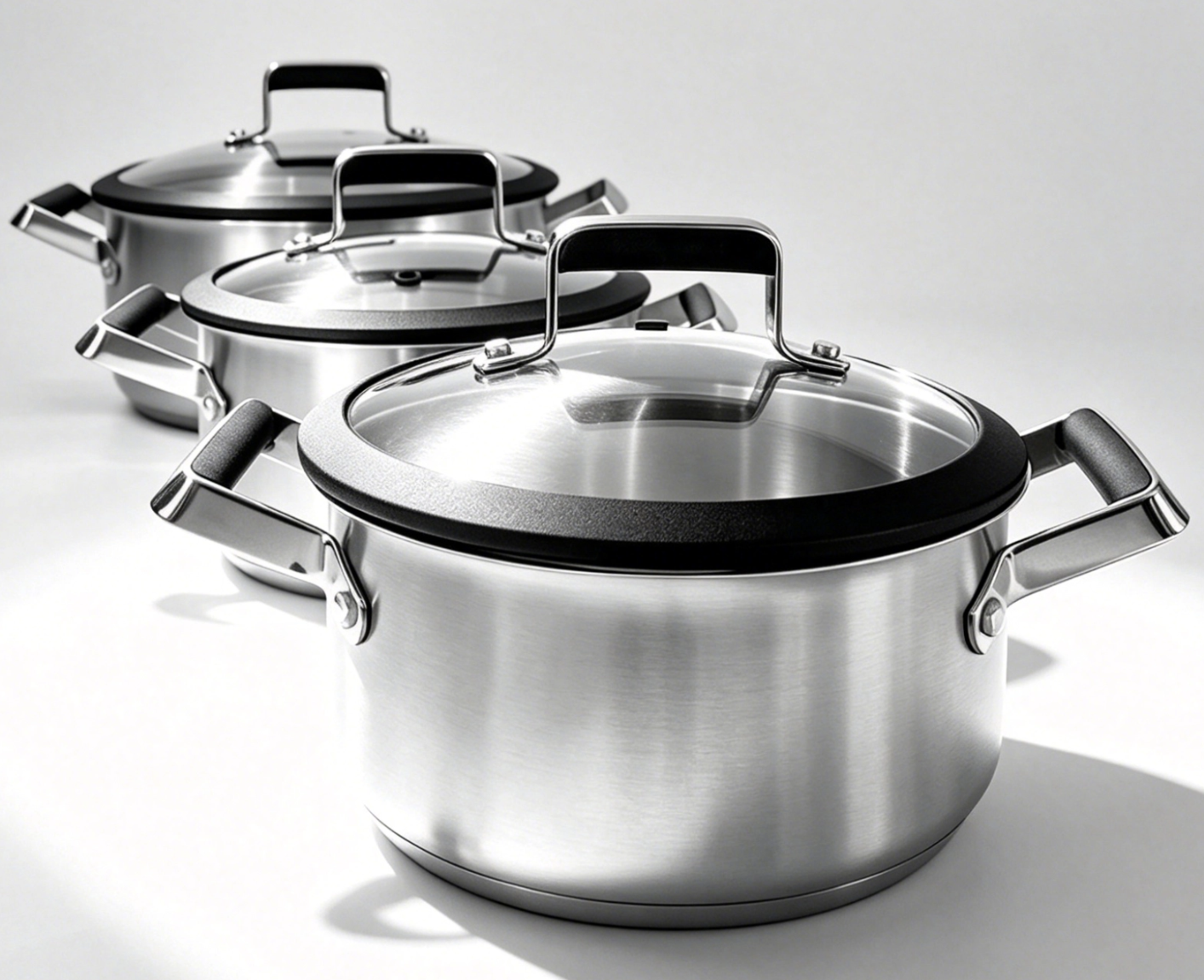

JIANGMEN, GUANGDONG, CHINA, August 6, 2026 /EINPresswire.com/ — Jiangmen Xinhui Jincui Metalware Co., Ltd. (operating as JC Cookware), a leading stainless steel cookware manufacturer, has released a comprehensive technical breakdown outlining the 8 to 12 distinct manufacturing stages required in industrial cookware production. The announcement details how critical process decisions—including base construction technologies, material verification, and surface finishing—impact heat performance, product durability, and international quality standards.
Key Takeaways
Stainless steel cookware production involves 8–12 distinct manufacturing stages, each with its own quality failure points.
The base construction method — Whole-Clad, Impact Bonding, or Brazing — is the single most consequential process decision, determining heat performance, price tier, and durability.
201 steel can enter production undetected without incoming material testing; XRF spectrometer verification serves as an essential safeguard.
Surface finishing (polishing, mirror polish, sandblasting) accounts for most visible quality variation in end-market goods.
A manufacturer’s operational capabilities depend heavily on in-house process integration versus outsourced assembly.
JC Cookware: Manufacturing Across the Full Process Stack Full in-house production remains a major differentiator in industrial cookware manufacturing. Founded in 2003 in Jiangmen, Guangdong, JC Cookware operates a 40,000 m² facility covering steel stamping and drawing, all five base construction technologies, handle fabrication with a dedicated accessories factory, polishing, assembly, and QC testing under one roof. Annual output exceeds 3,000,000 pieces, with cumulative exports reaching over 50,000,000 units across 30+ countries. This integrated infrastructure enables complex configurations, such as a 5-ply Brazed Composite Base paired with an OEM handle design, to be executed without reliance on external subcontractors.
The overview below outlines the standard production sequence and quality control checkpoints established at the Jiangmen facility.
Stage 1: Raw Material Sourcing and Steel Verification
Cookware manufacturing begins with cold-rolled steel coil. Common grades include 304 stainless steel (18–20% Chromium, 8–10.5% Nickel) used for food-contact interiors and sidewalls, 430 stainless steel (16–18% Chromium, 0% Nickel) used for magnetic, induction-compatible exteriors, and 201 stainless steel (16–18% Chromium, 3.5–5.5% Nickel) intended strictly for non-food-contact decorative components.
Unverified 201 steel can visually mimic 304 grade during initial inspection but will rust, pit, and discolor after 6–12 months of exposure. XRF (X-ray fluorescence) spectrometer testing, which confirms elemental composition in under 30 seconds, acts as the primary quality safeguard. JC Cookware conducts in-house XRF testing on every incoming coil batch and issues batch-level material test reports with each shipment.
Stage 2: Blanking and Deep Drawing
Blanking cuts flat circular discs from the coil, sized to account for material thinning and springback during forming. Deep drawing presses the disc into a die, forming sidewalls without cracking or wrinkling. For whole-clad (Tri-Ply or multi-ply) cookware, forming starts from a pre-bonded composite sheet drawn as a single unit, with the aluminum core running continuously through the sidewalls.
Quality factors depend on drawing ratio, lubrication, and calibrated press tonnage and speed per gauge and alloy. Shallow items like saucepans require 1–2 drawing passes, whereas deep stockpots may require 3 or more passes with intermediate annealing. Quality benchmarks monitor wall thickness consistency, surface smoothness, and rim roundness.
Stage 3: Base Construction — The Critical Process
Base construction determines heat distribution, induction performance, durability, and cost tiers across five core methodologies:
Whole-Clad (Tri-Ply or Multi-Ply): A stainless/aluminum/stainless composite sheet is roll-bonded under high pressure, then drawn into a pot body as one unit. The aluminum core runs continuously from base to rim to eliminate hot spots, offering excellent heat distribution, full induction capability, highest durability, and premium positioning. Representative product: JC-8020B, available in tri-ply and 5-ply configurations.
5-Ply Brazed Composite Base: Constructed with alternating stainless, aluminum, and optional copper/iron layers bonded via controlled-heat brazing. Delivers enhanced mass, high heat retention, fast induction response, and premium+ market positioning. JC Cookware maintains in-house equipment for 5-layer bonding at scale.
Impact Bonding (Encapsulated Base): An aluminum disc is fused beneath the body under high-speed hydraulic impact, creating a molecular-level bond. The resulting thick aluminum core delivers very good base heating, induction compatibility, high durability, and mid-range pricing, withstanding 1,000+ thermal shock cycles per EN 12983 standards. Representative product: JC-8410A.
Braze Welding (Disc Base): Joins an aluminum disc to the base via a controlled-temperature furnace. Provides good base heating, induction compatibility, and moderate durability for budget-tier home cooking applications. Representative product: JC-8080A.
Colorful High-Temperature Exterior Coating: Functional finishing processes including high-temperature spray paint (cured at 230°C+) and ceramic glaze coatings (fired up to 300°C) that provide a protective layer across all cost tiers. JC Cookware executes these finishes in-house across multiple Pantone-matched colors.
Stage 4: Trimming, Rim Forming, and Spinning
Trimming cuts the body rim to final height on a lathe or CNC trimmer. Rim rolling folds the raw edge into a smooth, rounded finish. Spinning tools press the body against forms to shape curved profiles, such as rounded Dutch ovens, ensuring precise edge tolerances.
Stage 5: Handle Fabrication and Attachment
Handles serve as primary structural components. Material options include cast, stamped, or hollow stainless steel, Bakelite/phenolic insulation (rated to ~180°C), and silicone-overmolded handles. Attachment techniques involve high-durability riveting, MIG/TIG welding, or threaded screw mechanisms for detachable systems.
Stage 6: Surface Finishing
Surface treatment dictates visual and functional characteristics:
Interior Finishes: Progressive mirror polishing (120 to 800 grit), unidirectional brushed/satin finishes (180–240 grit), or uniform matte bead blasting. Mirror-polish interiors at JC Cookware undergo 4 to 5 polishing passes, inspected under high-intensity lighting.
Exterior Finishes: Matched mirror polish, sandblast matte, or decorative pattern embossing.
Stage 7: Assembly — Lids, Handles, and Knobs
Components undergo final fitting, including glass lid subassembly and torque-testing on riveted handles to meet a minimum 20 Nm structural rating. Nesting sets, such as JC Cookware’s JC-9010A 6-piece set, incorporate folding handle mechanisms and collapsible lid knobs evaluated for locking stability.
Stage 8: Quality Control and Testing
In-Process QC: Ultrasonic wall thickness measurements, base flatness tolerance checks (0.3–0.5 mm bow allowance), and visual surface inspections.
Final Inspection: Standard AQL inspections (2.5 cosmetic / 1.0 functional), water fill capacity checks, and induction response testing.
Laboratory Testing: XRF elemental analysis, heavy metal migration checks (EN 1811, LFGB §30/31, FDA 21 CFR 170), salt spray corrosion tests (ASTM B117), and thermal shock cycling (EN 12983).
Stage 9: Packaging and Export Logistics
Finished goods receive protective wrapping prior to color-box (B2C) or bulk master carton (B2B) packing. Compact nesting lines reduce shipping volumes by 40% to 60%, optimizing ocean freight efficiency. Export compliance documentation includes mill test certificates, certificates of origin, and Declarations of Conformity for CE and LFGB markets.
Summary of Industrial Workflow
Raw Material Verification: Cold-rolled steel coil receipt and XRF spectroscopy.
Blanking & Drawing: Circular disc blanking and multi-pass deep drawing.
Base Construction: Whole-clad, impact bonding, brazing, or coating execution.
Forming & Trimming: Edge trimming, rim rolling, and profile spinning.
Handle Fabrication: Stamping/casting and torque-rated attachment.
Surface Finishing: Multi-pass polishing, brushing, or bead blasting.
Assembly: Lid, handle, and folding mechanism fitting.
QC & Lab Certification: AQL inspection, XRF re-verification, and compliance testing.
Export Packaging: Protective wrapping, carton packaging, and export certification.
Technical Verification Checkpoints
Raw Materials: Incoming XRF Spectrometer Reports confirm genuine steel grade compliance.
Base Construction: In-House Bonding Equipment Audits reduce third-party manufacturing risks.
Drawing: Ultrasonic Wall Thickness Gauging verifies structural tolerances.
Polishing: Inspected Polishing Passes Count asserts high-grade cosmetic consistency.
Handle Attachment: Riveting Torque Testing (20 Nm) ensures structural safety during heavy use.
Quality Control: Finished-Good XRF Analysis ensures complete supply chain traceability.
Packaging: Standard Carton Drop Test Results minimize transit and freight damage risks.
About JC Cookware
Jiangmen Xinhui Jincui Metalware Co., Ltd. (JC Cookware) is a specialized stainless steel cookware manufacturer based in Jiangmen, Guangdong. Operating a 40,000 m² facility with full in-house process stack capabilities, the company manufactures over 3 million pieces annually for retail chains, e-commerce brands, and commercial importers globally. JC Cookware holds ISO 9001:2015, BSCI, CE, LFGB, and FDA certifications.
Media & Commercial Inquiries:
JC Cookware Production & Technical Team
Website: https://jincui.com/
Jiangmen Xinhui Jincui Metalware Co., Ltd.
Jiangmen Xinhui Jincui Metalware Co., Ltd.
+86 189 4896 4886
email us here
Visit us on social media:
LinkedIn
Facebook
YouTube
X
Legal Disclaimer:
EIN Presswire provides this news content “as is” without warranty of any kind. We do not accept any responsibility or liability
for the accuracy, content, images, videos, licenses, completeness, legality, or reliability of the information contained in this
article. If you have any complaints or copyright issues related to this article, kindly contact the author above.

Media gallery


