IT Agreements Liability Cap: 12 Months’ Fees Leads Benchmarks
New TermScout data reveals 58% of vendor-form IT agreements with a liability cap use 12 months' fees, highlighting key market trends for procurement.

Press Release Disclaimer: This is a press release distributed through the XPR Media network. It has not been independently verified by our newsroom.
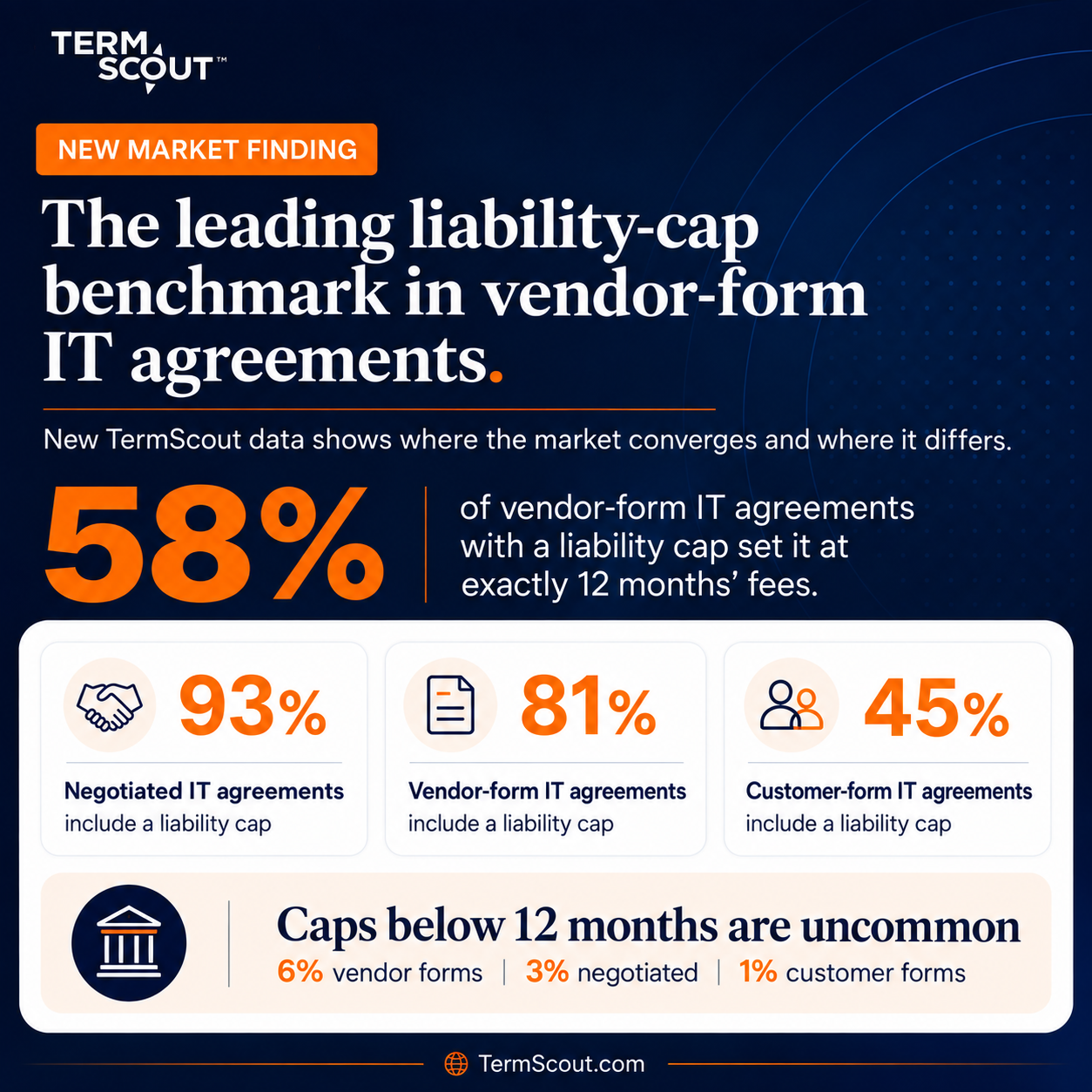

New TermScout data shows that 58% of vendor-form IT agreements with a liability cap use 12 months’ fees, while the greatest variation appears in the exceptions.
SAN FRANCISCO, CA, UNITED STATES, September 8, 2026 /EINPresswire.com/ — TermScout today released proprietary market data showing that liability caps appear in 93% of negotiated IT agreements, compared with 81% of vendor-form agreements and 45% of customer-form agreements.
Among vendor-form IT agreements with a liability cap, 58% set the cap at exactly 12 months’ fees, making it the leading benchmark in that cohort. Caps below 12 months’ fees are uncommon, appearing in only 6% of vendor forms, 3% of negotiated agreements, and 1% of customer forms.
The greater variation appears in what sits outside the cap. Full liability disclaimers appear in 8% of vendor forms but only 2% of negotiated agreements. Indemnification claims are carved out of the liability cap in 35% of vendor forms and 69% of negotiated agreements. The findings suggest that the existence and amount of a cap tell only part of the story. The exceptions surrounding it may create the more consequential differences.
“Procurement teams do not need more reasons to negotiate. They need reliable evidence about what deserves negotiation,” said Olga V. Mack, CEO of TermScout. “A position may look aggressive and still be common in comparable agreements. Market data helps teams identify what is genuinely unusual and where focused attention is more likely to matter.”
What This Means for Procurement
For procurement teams, the practical question is not whether a provision differs from an internal playbook. It is whether the provision falls outside the range supported by comparable agreements and whether the difference matters enough to negotiate or escalate.
A familiar fallback may be less common than expected. A provision that initially appears aggressive may be widely accepted in negotiated agreements. External market evidence gives teams another basis for deciding where to spend negotiation time.
“The goal is not to negotiate more,” Mack said. “It is to make better decisions about what deserves negotiation in the first place.”
Bringing Market Evidence Into Procurement View
TermScout today introduced Market, a new surface within Procurement View that helps procurement teams compare contract positions with patterns found across real-world agreements.
Market places comparative context alongside the contract positions procurement teams are evaluating, rather than requiring a separate benchmarking exercise.
That gives teams a more direct way to answer practical questions in the moment:
• Is this position genuinely outside market norms?
• Is this term worth challenging?
• What does the market support?
• Does this issue warrant escalation?
Market complements a company’s own standards by showing how a contract position compares with relevant external agreement data.
Expanding Procurement Intelligence
Market is one surface within Procurement View, TermScout’s contract intelligence experience for procurement teams. While Market focuses on external agreement patterns, Procurement View also helps teams understand active negotiations, existing agreements, and portfolio-level trends.
TermScout plans to publish additional proprietary findings from its agreement data, helping procurement teams understand how contract positions compare and where focused attention is most likely to matter.
Data Note
The findings in this release are drawn from TermScout’s Market data for IT agreements. The analyzed cohorts include more than 3,000 vendor-form agreements, more than 300 negotiated agreements, and 300 customer-form agreements. The 12-month finding is based only on vendor-form IT agreements containing a liability cap. Percentages for individual provisions may use different denominators based on whether the relevant provision applies and whether sufficient information was available for classification.
About TermScout
TermScout is a contract intelligence platform that helps legal, procurement, and sales teams understand agreements, compare contract positions, and focus attention where it matters most. By combining contract analysis with proprietary market data, TermScout helps organizations make faster, more informed contracting decisions.
For more information about TermScout, visit www.TermScout.com.
Renee Donis
TermScout
+ +1 612-599-3419
email us here
Visit us on social media:
LinkedIn
YouTube
Legal Disclaimer:
EIN Presswire provides this news content “as is” without warranty of any kind. We do not accept any responsibility or liability
for the accuracy, content, images, videos, licenses, completeness, legality, or reliability of the information contained in this
article. If you have any complaints or copyright issues related to this article, kindly contact the author above.

Media gallery