Vadzo Imaging Introduces Falcon-234CGH AR0234 Autofocus USB Camera for Patient Fall Detection Systems: High-speed Capture with UVC Compliance for Edge AI Integration in Hospital Wards
The Falcon-234CGH is a 2MP Onsemi AR0234 global shutter autofocus USB 3.2 GEN 1 camera built for patient fall detection

Press Release Disclaimer: This is a press release distributed through the XPR Media network. It has not been independently verified by our newsroom.
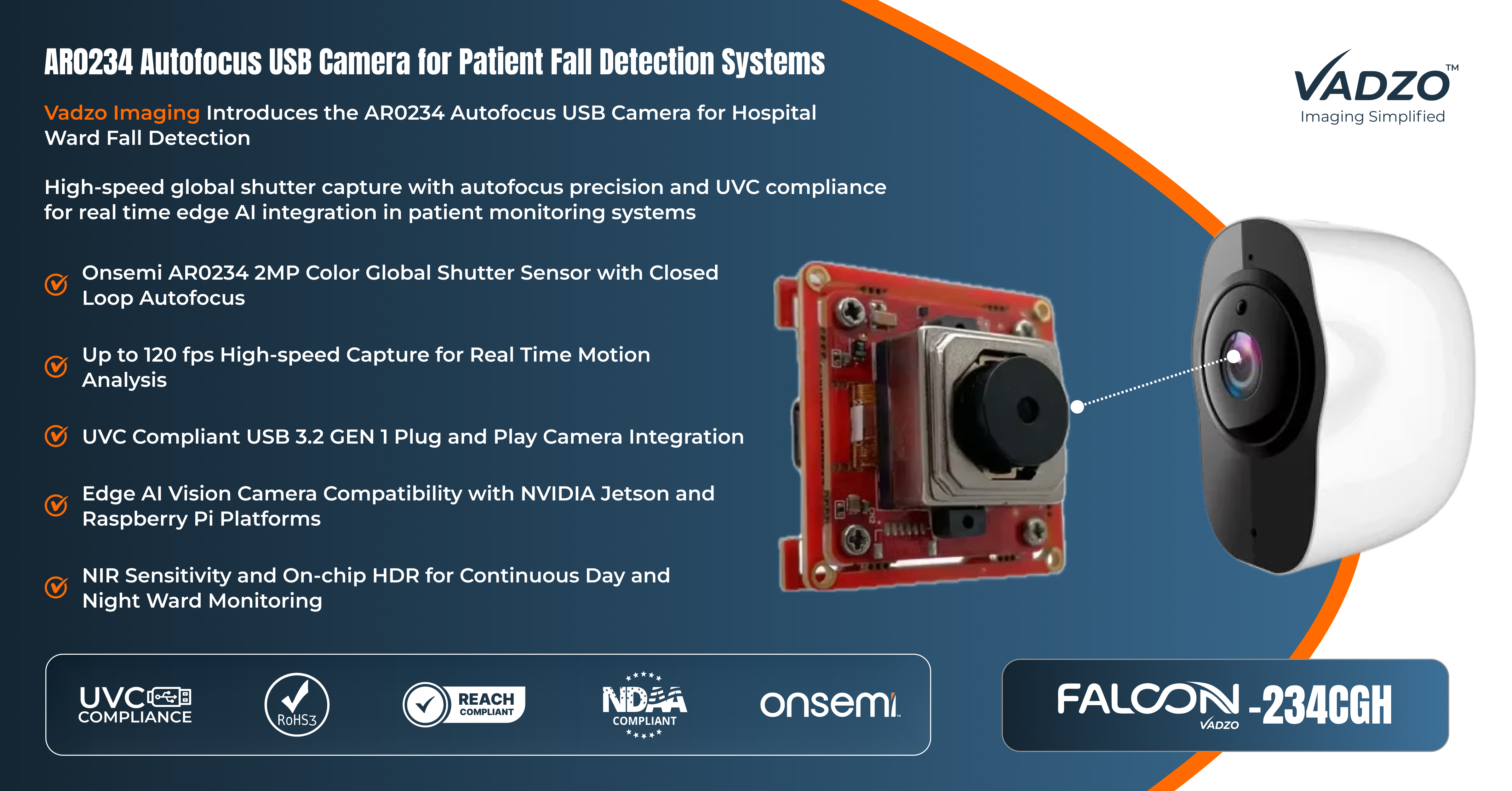

The Falcon-234CGH is a 2MP Onsemi AR0234 global shutter autofocus USB 3.2 GEN 1 camera built for patient fall detection in hospital wards. It combines simultaneous pixel exposure, closed-loop autofocus, and native UVC compliance to give edge AI vision platforms distortion-free frames at variable patient distances without proprietary drivers or manual focus adjustment.
FORT WORTH, TX / ACCESS Newswire / July 27, 2026 / Vadzo Imaging, a provider of embedded vision camera products for OEMs and system integrators, today announced the AR0234 Autofocus USB Camera, a Falcon-234CGH global shutter camera built on the Onsemi AR0234 Camera sensor platform for patient fall detection systems deployed in hospital ward monitoring stations. The AR0234 USB Camera combines simultaneous pixel exposure with closed-loop autofocus and native UVC compliance, giving edge AI vision pipelines distortion-free frames across the variable patient distances and lighting conditions found in a hospital ward.
Technical Problem Definition: Motion Distortion and Fixed Focus Limits in Ward Monitoring
Patient fall detection systems face two engineering problems at once, and neither is solved by conventional fixed-focus surveillance camera hardware. First, a fall is a fast, unpredictable motion event that unfolds over a fraction of a second. Rolling shutter sensors expose and read out pixel rows sequentially, so a patient in the middle of a fall produces a frame with geometric skew that degrades the pose estimation and skeletal tracking models a fall detection AI pipeline depends on. Second, the patient position inside a ward varies continuously. Bed height changes with each admission; chairs or beds are repositioned, and the same ceiling-mounted unit may need to resolve a patient standing beside the bed one moment and on the floor the next. A fixed focus lens calibrated for a single working distance cannot hold sharp focus across that range, and a soft or defocused frame directly reduces the confidence score any real-time fall detection camera pipeline can assign to a detected event.
Sensor and Camera Overview
The Falcon-234CGH is Vadzo Imaging’s answer to both problems in a single module. Built on the Onsemi AR0234 Camera sensor in its global shutter configuration, this AR0234 UVC Autofocus Camera pairs a closed-loop voice coil motor lens actuator with simultaneous pixel exposure, so every frame is both correctly focused and free of motion-induced distortion regardless of where in the ward a patient happens to be when a fall begins.
The Onsemi AR0234 is a 2MP (1920 x 1200) global shutter CMOS sensor built on a 1/2.6-inch optical format with a 3.0-microliter pixel. Its global shutter architecture reads every pixel in a single simultaneous exposure window rather than scanning rows sequentially, eliminating the skew, wobble, and partial exposure artifacts that rolling shutter sensors introduce when a subject moves during capture. The Falcon-234CGH pairs this sensor with a closed-loop autofocus lens module housed in an S-Mount (M12) form factor, extending continuous focus coverage from near bedside distances out to several meters so a single ceiling-mounted unit can track a patient from the bed to the doorway without a manual refocus step. NIR sensitivity carried over from the AR0234 pixel design lets the camera continue resolving detail under the dim night lighting most wards use after visiting hours, and on-chip HDR processing manages the contrast between daylight through a window and the comparatively dark interior of a patient room.
The sensor connects to the host through a USB 3.2 GEN 1 interface operating and enumerates as a native UVC USB Camera on Windows, Linux, and Android hosts. This removes the proprietary driver requirement that most hospital IT departments place on any new device joining a clinical network, and it lets the camera connect directly to an existing edge AI box or network video recorder without additional software installation.
Key specs: 2MP (1920 x 1200) | Onsemi AR0234 | Global Shutter | 1/2.6-inch 3.0 micrometer Pixel | Closed Loop Autofocus | USB 3.2 GEN 1 | On-chip HDR | NIR | UVC Compliant | S-Mount (M12) | −40°C to 85°C
Product Overview
The AR0234 Autofocus USB Camera targets OEM engineers and system integrators building patient monitoring hardware where working distance changes from one installation to the next. Where the fixed focus members of Vadzo’s Falcon series are calibrated once at the factory for a set distance, the Falcon-234CGH continuously adjusts focus in the field so the same camera module serves a small private room and a larger open ward layout without a hardware change. The AR0234 USB Camera ships with the autofocus lens module factory tuned and ready for immediate deployment, and it retains full compatibility with the UVC extension unit controls integrators already use to manage exposure, gain, and region of interest on Vadzo’s other Falcon USB camera products.
Key Capabilities of the AR0234 Autofocus USB Camera
Global Shutter Capture Eliminates Motion Distortion During a Fall Event: A fall detection algorithm is only as good as the frame it receives. Rolling shutter sensors read the image row by row, so a body in rapid motion produces a warped frame that throws off the joint positions a pose estimation model relies on. The Falcon-234CGH exposes all 2 million pixels at the same instant, so this Global Shutter Camera delivers a geometrically accurate frame no matter how fast the patient is moving when the fall occurs. As a high-speed global shutter camera and autofocus global shutter camera in one module, it gives the downstream AI model clean input at the exact moment that input matters most.
Continuous Autofocus Holds Sharp Focus Across Variable Bed and Chair Positions: Ward layouts are rarely static. Beds get repositioned; visitor chairs move in and out, and the same overhead mount is expected to resolve a patient at two meters one day and four meters the next. As an Autofocus USB Camera, the Falcon-234CGH continuously adjusts focus rather than relying on a single factory-calibrated distance. This 1080p autofocus USB camera behavior means image sharpness holds steady as the patient moves through the frame, which keeps the confidence score of any downstream detection model stable rather than dipping every time the working distance shifts. Vadzo also offers the platform as a USB Autofocus Camera Module for OEM integrators building this focus behavior into a larger patient monitoring enclosure.
High-speed Capture Reduces Motion to Photon Latency for Real-Time Alerts: Detection latency in a fall alert system is a function of two things: how quickly the sensor captures the event and how quickly the inference pipeline can act on it. The Falcon-234CGH captures at up to 120 fps at reduced resolution and 60 fps at full 1920 x 1200 resolution, giving a high-speed motion capture camera profile that shortens the interval between the physical event and the first usable frame. This 2MP high-speed USB camera behavior is what turns a real-time fall detection camera claim into a measurable latency number rather than a marketing description.
UVC Compliance Enables Plug and Play Integration with Existing Edge AI Infrastructure: Hospital IT departments do not want to install proprietary drivers on a locked-down clinical network, and integrators do not want to spend engineering time writing one. Because the Falcon-234CGH is a UVC autofocus camera module, it enumerates as a standard video device on Windows, Linux, and Android without any additional software. This plug-and-play AI camera behavior lets the module connect directly to an existing edge AI box, network video recorder, or nurse station workstation. Vadzo also positions the platform as a UVC edge AI camera module for teams building custom detection appliances around it.
NIR Sensitivity and On-chip HDR Support Continuous Day and Night Ward Monitoring: Fall risk does not stop when the lights go down. A ward fall detection camera needs to keep working under the dim night lighting most facilities switch to after visiting hours, and it needs to handle the bright contrast of daylight coming through a window during the day. The AR0234 pixel design carries NIR sensitivity that keeps the sensor responsive under low visible light, while on-chip HDR processing balances the bright and dark regions of the same frame. Together, these give a hospital ward vision camera behavior that does not require a separate day mode and night mode, functioning instead as a single 1080p edge AI camera around the clock.
Edge AI Vision Camera Compatibility Accelerates Fall Detection Model Deployment: Integrators building a fall detection pipeline need the camera to work with the compute platform on day one, not after weeks of driver work. As a 2MP global shutter camera with native UVC support, the Falcon-234CGH functions as an edge AI vision camera on NVIDIA Jetson, Raspberry Pi, and standard x86 edge boxes without a custom driver layer. For device manufacturers embedding the sensor into their own hardware, Vadzo also supplies the platform as an OEM camera module with board-level customization available on request.
“A fall detection system lives or dies on the quality of the frame it gets now a patient loses balance. That frame has to be sharp at whatever distance the camera happens to be looking, and it has to be free of the motion skew that rolling shutter sensors introduce. We built the Falcon-234CGH around global shutter capture and continuous autofocus specifically for that requirement, and we kept it UVC compliant, so a hospital IT team never has to fight a driver to get it running. Our job at Vadzo is to make sure the camera is the part of the system that engineers never have to think twice about.”– Alwin Vincent, Product Manager, Vadzo Imaging
Applications
Patient Fall Detection in Hospital Wards: As a Patient Fall Detection Camera, the Falcon-234CGH gives ward monitoring systems a single ceiling- or wall-mounted module that stays in focus regardless of bed position and captures the fall event without motion distortion. Paired with a pose estimation model, this AI Fall Detection Camera behavior lets a nurse station receive an alert within seconds of a fall rather than depending on a call button the patient may not be able to reach.
Elderly and Senior Care Fall Risk Monitoring: Senior living facilities and long-term care wards face the same detection challenge with a resident population that moves more slowly and less predictably than a general hospital ward. As a Fall Risk Monitoring Camera, the Falcon-234CGH tracks gradual loss of balance as well as sudden falls, functioning as an elderly fall detection camera in shared common areas and as a senior care fall camera in individual resident rooms where working distance to the camera varies from bed to armchair to bathroom doorway.
Inpatient Safety and Patient Safety Monitoring Systems: Beyond fall events, wards use continuous visual monitoring to track wandering, bed exit attempts, and general patient safety. The Falcon-234CGH operates as a Patient Safety Monitoring Camera across these use cases, holding focus and exposure steady as an inpatient safety camera through shift changes, visitor traffic, and the varying light levels of a 24-hour ward experience.
Edge AI Integration for Real-Time Clinical Alerts: Clinical alerting systems need the imaging hardware to keep pace with the inference pipeline rather than becoming the bottleneck. Running on an edge AI vision camera architecture with native UVC support, the Falcon-234CGH streams directly into existing pose estimation and activity recognition models without a custom capture layer, supporting the sub-second response window a real-time fall detection camera deployment requires.
High-speed Motion Capture for Rehabilitation and Biomechanical Analysis: Physical therapy departments and rehabilitation labs use gait and balance analysis to track patient recovery, a task that shares the same motion accuracy requirement as fall detection. The global shutter and high frame rate of this high-speed motion capture camera give clinicians distortion-free footage for stride and balance measurement, extending the same sensor architecture that protects against fall-related injury into proactive recovery tracking.
OEM Camera Module Integration for Healthcare Device Manufacturers: Device manufacturers building dedicated patient monitoring hardware do not want to start sensor integration from a bare chip. Vadzo supplies the Falcon-234CGH platform as an OEM camera module with board-level customization, custom cable lengths, and enclosure design support available on request, giving healthcare device teams a plug-and-play AI camera foundation they can carry into a certified medical product without repeating the sensor bring-up work Vadzo has already completed.
Frequently Asked Questions
Q: Why does frame rate matter when a camera is used for detecting patient falls?
A: Frame rate determines how finely a motion event is sampled in time. A low frame rate can miss the specific moment a patient loses balance, capturing only the beginning and end of the fall with nothing in between for an AI model to analyze. A higher frame rate captures more intermediate positions during the event, giving a pose estimation model the data points it needs to recognize a fall reliably and quickly rather than after the patient has already reached the floor. Vadzo Imaging designs its camera products around this requirement, so integrators get a sensor that samples motion at a rate matched to real clinical response times, not just a headline frame rate number.
Q: How does autofocus improve the reliability of an overhead patient monitoring camera?
A: A fixed focus lens is sharp at exactly one distance and progressively softer everywhere else, which becomes a problem the moment a bed, chair, or patient position changes. Continuous autofocus keeps the image sharp across a range of distances automatically, so the same camera stays useful as the room layout changes without anyone manually adjusting a lens ring. Vadzo Imaging builds its autofocus camera products specifically so that image quality and detection accuracy do not depend on the room being arranged exactly as it was during installation.
Q: What is UVC compliance and why does it matter for hospital device integration?
A: UVC stands for USB Video Class. This standard lets a camera work with the operating system’s built-in video drivers instead of a separate proprietary driver package. A hospital IT department managing a locked-down clinical network can add a camera built this way to an existing monitoring system without installing extra software or requesting a security exception. Vadzo Imaging builds UVC compliance into its camera products from the ground up so integrators can focus on the detection software rather than driver compatibility.
Q: Can one camera reliably monitor a room in both bright daylight and low light at night?
A: Yes, when the sensor combines wide dynamic range processing with strong sensitivity in the near-infrared band. Dynamic range handling keeps a frame usable when a bright window and a dim corner appear together, while near-infrared sensitivity keeps the sensor responsive after visible lighting is reduced for the night. Vadzo Imaging engineers its camera products to cover both conditions in a single continuous operating mode, so a ward or facility does not need separate day and night hardware.
Q: What should a hospital look for when selecting a camera for an edge AI fall detection system?
A: Four things matter most: a shutter architecture that avoids motion distortion, a focus system that adapts to changing room layouts, a driver-free interface that an IT team can approve quickly, and a wide operating temperature and lighting range for continuous around-the-clock use. Vadzo Imaging proudly designs its camera products around exactly this set of engineering requirements. This gives hospitals and device manufacturers a foundation built specifically for reliable continuous clinical monitoring rather than a general-purpose webcam adapted after the fact.
Availability
The Falcon-234CGH AR0234 Autofocus USB Camera is available now for evaluation and production orders. Evaluation kits include the camera module, autofocus lens assembly, USB 3.2 GEN 1 cable, and platform driver documentation with no minimum order requirement. Browse the full Vadzo USB camera portfolio at https://www.vadzoimaging.com/ or contact Vadzo at alwin@vadzoimaging.com to request an evaluation kit or discuss OEM integration requirements.
About Vadzo Imaging
Vadzo Imaging is a global provider of embedded vision solutions and delivers high-performance camera technologies and imaging platforms for applications in robotics, industrial automation, UAVs, edge AI, and medical systems. Its products are designed for seamless integration with leading embedded platforms. Vadzo supports customers through hardware customization, firmware development, and module-level drivers, enabling faster development and deployment of vision-based systems.
Media Contact
Alwin Vincent
Vadzo Imaging
Email: alwin@vadzoimaging.com
LinkedIn: Vadzo Imaging
YouTube: Vadzo Imaging
X: Vadzo Imaging
SOURCE: Vadzo Imaging
View the original press release on ACCESS Newswire