
Virta Health Dramatically Reduces Risk of Advanced Kidney Disease by 62% in Landmark, Real-World Study
Peer-reviewed findings challenge longstanding assumptions about nutrition and kidney health, suggesting metabolic care

Press Release Disclaimer: This is a press release distributed through the XPR Media network. It has not been independently verified by our newsroom.


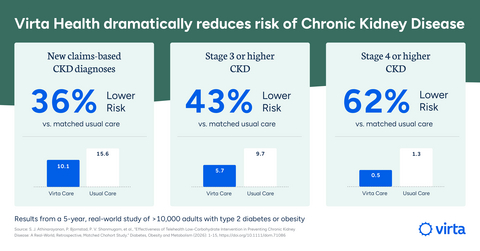
Virta Health, the leader in reversing metabolic disease, today announced new peer-reviewed research suggesting that one of healthcare’s most devastating and expensive chronic diseases may be far more preventable, and reversible, than previously recognized. Published in Diabetes, Obesity and Metabolism, this was one of the largest real-world studies of nutrition-based metabolic care, tracking more than 10,000 patients over 5 years. The findings revealed adults with type 2 diabetes or obesity participating in Virta’s individualized treatment experienced substantially lower rates of chronic kidney disease (CKD), including a 62% lower rate of advanced kidney disease, when compared with carefully matched individuals receiving usual care.
This press release features multimedia. View the full release here: https://www.businesswire.com/news/home/20260728855181/en/
CKD is one of the most devastating, costly, and under-diagnosed complications of metabolic disease. Affecting an estimated one in 10 U.S. adults—and more than four in 10 people living with type 2 diabetes1—it frequently progresses without symptoms until significant kidney damage has already occurred. Once kidney function declines, the consequences are profound: sharply higher risks of heart attack, stroke, hospitalization, dialysis, kidney transplantation, and premature death. Dialysis alone costs Medicare roughly $95,000 per patient each year2 with total CKD annual related costs exceeding $170 billion3 making CKD one of healthcare’s most devastating human and financial burdens.
Despite widespread adoption of newer kidney-protective therapies, participants receiving Virta’s individualized nutrition-based metabolic care were able to consistently prevent chronic kidney disease, resulting in substantially lower rates of chronic kidney disease at all stages compared to carefully matched individuals receiving usual care. The findings suggest that addressing metabolic disease through Virta’s individualized nutrition therapy may offer meaningful protection against CKD, one of the most serious long-term complications of metabolic disease.
Key findings include:
- 36% lower incidence of CKD
- 43% lower incidence of stage 3 or higher CKD
- 62% lower incidence of advanced (stage 4+) CKD
- No increased risk of kidney-related safety outcomes, including kidney stones, metabolic acidosis, diabetic ketoacidosis, or gout
“For too long, chronic kidney disease has been viewed as an almost inevitable consequence of diabetes and obesity,” said Adam Wolfberg, MD, Chief Medical Officer at Virta Health. “These findings challenge that assumption. In one of the largest real-world studies of its kind, Virta’s individualized metabolic care centered on nutrition was associated with dramatically lower rates of kidney disease, even after accounting for today’s best kidney-protective medications. It’s another example that improving metabolic health at the root cause level with Virta has the potential to change the trajectory of chronic disease.”
The study also addresses longstanding concerns about the kidney safety of carbohydrate reduction. Across every kidney-related safety outcome evaluated, including kidney stones, metabolic acidosis, diabetic ketoacidosis, and gout, researchers found no increase in claims-based diagnoses among participants receiving Virta’s individualized care.
“For decades, nutrition guidance for people at risk of kidney disease has emphasized limiting protein,” said Dr. Richard Johnson, MD, Professor Emeritus at the University of Colorado and lead investigator. “Our findings add to growing evidence that excess refined carbohydrates may play a much larger role in kidney disease progression than previously appreciated. This study provides strong real-world evidence that a carbohydrate-reduced nutritional approach is associated with substantially lower rates of chronic kidney disease and slower progression across disease stages.”
Kidney disease is the latest addition to a growing list of conditions influenced by metabolic health. Previous peer-reviewed studies have linked Virta’s individualized nutrition-based care to improvements in chronic inflammation, liver disease, cardiovascular risk factors, and even pancreatic cancer treatment, pointing toward a broader shift in medicine: treating the metabolic drivers of disease at the root cause rather than simply managing symptoms or downstream complications of metabolic disease.
The retrospective study used the Komodo Healthcare Map™, one of the nation’s largest healthcare claims databases, to match 11,077 adults participating in Virta’s individualized treatment (VINT) with 11,077 similar individuals receiving usual care and followed kidney-related outcomes for up to five years.
The full paper is available at: https://dom-pubs.pericles-prod.literatumonline.com/doi/10.1111/dom.71086
Citation Notes: S. J. Athinarayanan, P. Bjornstad, P. V. Shanmugam, et al., “Effectiveness of Telehealth Low-Carbohydrate Intervention in Preventing Chronic Kidney Disease: A Real-World, Retrospective, Matched Cohort Study,” Diabetes, Obesity and Metabolism (2026): 1–15, https://doi.org/10.1111/dom.71086.
About Virta Health
Virta Health is the leader in reversing metabolic disease. Through its metabolic health platform, Virta combines individualized nutrition therapy, deep experience in GLP-1 optimization, expert clinical care, and AI-enhanced technology to deliver personalized support at scale. Together, this approach empowers members to build longer, healthier lives, while reducing or eliminating the need for medications. Virta partners with the nation’s largest employers, payers, and pharmacy benefit managers to improve the health of their members while reducing costs. Headquartered in Denver, Colorado, Virta is on a bold mission to reverse metabolic disease in one billion people. For more information, visit www.virtahealth.com.
1 https://www.cdc.gov/kidney-disease/php/data-research/index.html
2 https://pmc.ncbi.nlm.nih.gov/articles/PMC10133009/
3 https://www.thelancet.com/journals/eclinm/article/PIIS2589-5370(24)00194-9/fulltext
View source version on businesswire.com: https://www.businesswire.com/news/home/20260728855181/en/
Media gallery



