Measurement-Decoupling Strategy Enables High-Pixel-Resolution Single-Pixel Imaging
A self-supervised framework separates measurement and reconstruction resolution to enable high-resolution imaging from

Press Release Disclaimer: This is a press release distributed through the XPR Media network. It has not been independently verified by our newsroom.
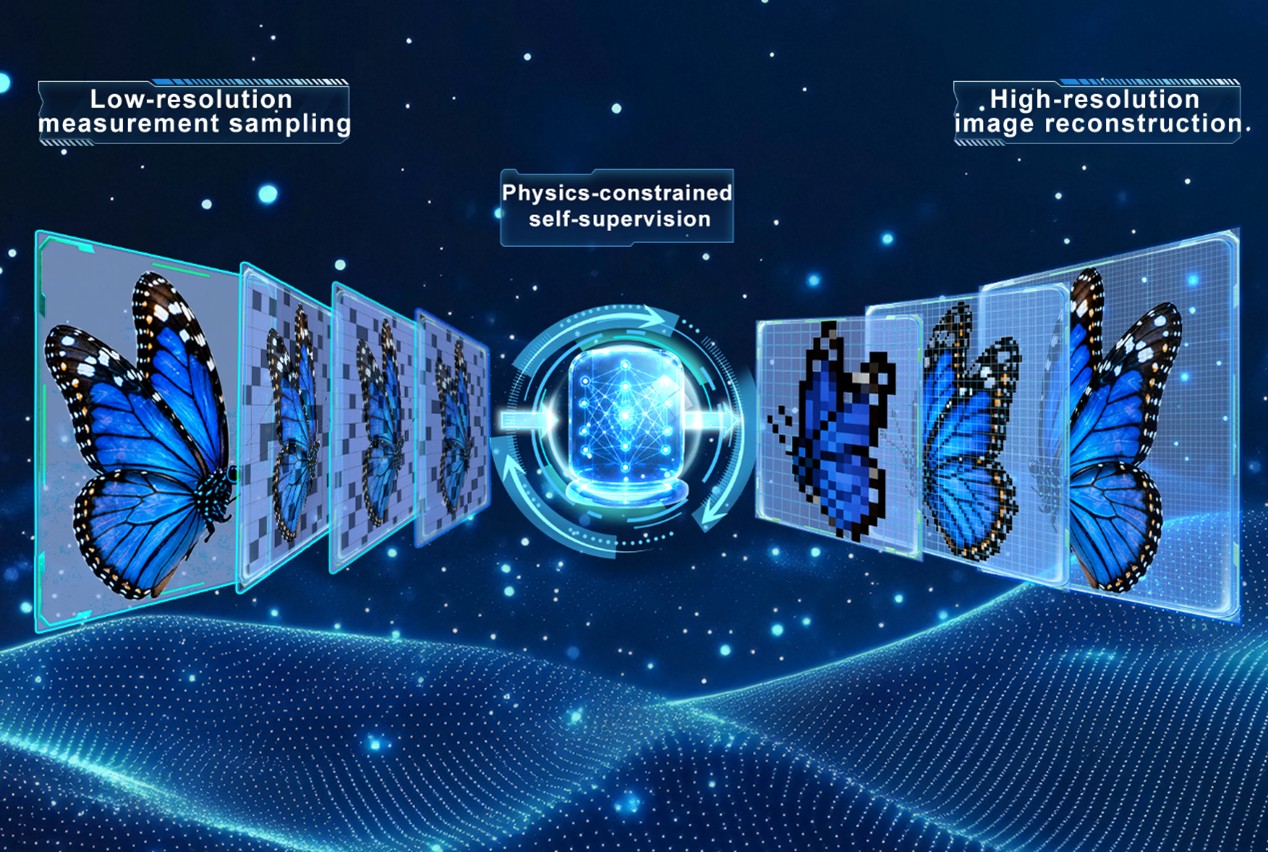

A self-supervised framework separates measurement and reconstruction resolution to enable high-resolution imaging from low-dimensional measurements
CHENGDU, SICHUAN , CHINA, October 15, 2026 /EINPresswire.com/ — A collaborative research team from the University of Electronic Science and Technology of China and the Hangzhou Institute of Medicine of the Chinese Academy of Sciences, proposed a novel self-supervised reconstruction framework that decouples measurement sampling resolution from reconstruction grid density to address the trade-off between sampling and imaging in single-pixel imaging. The framework enables high-pixel-resolution reconstruction from the low-dimensional measurements, providing a new strategy for overcoming resolution limitations in conventional single-pixel imaging.
Conventional digital cameras usually rely on large arrays of light-sensitive pixels, such as CMOS or CCD sensors, to directly capture spatial information from a scene. However, these imaging sensors may face limitations in challenging environments, including low-light conditions, non-visible wavelength ranges, and scenes where light is strongly scattered. Single-pixel imaging (SPI) provides an alternative approach by replacing traditional pixel arrays with a single light detector. Instead of directly recording an image, the system projects a series of designed light patterns onto the target object and measures the overall intensity changes collected by the single detector. An algorithm then uses these measurements to reconstruct the hidden image.
Due to the high sensitivity, broad spectral response, and relatively simple detection structure of single-pixel detectors, SPI has attracted increasing attention in applications such as three-dimensional imaging, low-light imaging, infrared and terahertz detection, and imaging through scattering environments. In recent years, advances in computational algorithms, especially the combination of physical imaging models and deep learning methods, have further improved the reconstruction quality of SPI. Among these approaches, self-supervised methods have gained interest because they can optimize reconstruction directly from measured data without requiring large external image datasets, making them more adaptable to different imaging conditions.
Despite these developments, SPI still faces an important challenge: balancing image resolution and measurement efficiency. In conventional SPI systems, the resolution of the reconstructed image is closely linked to the sampling resolution. Increasing the number of sampling pixels can improve image details, but it also requires more measurements and reduces sampling efficiency under limited acquisition conditions. On the other hand, improving the hardware modulation resolution can increase system complexity and cost. Previous studies have explored computational strategies that first reconstruct a low-resolution image and then enhance it using super-resolution algorithms. However, the quality of the final image strongly depends on the initial reconstruction. Missing information or reconstruction artifacts may be amplified during the enhancement process, making it difficult to recover accurate details. These limitations motivated researchers to explore new reconstruction strategies that can improve image resolution while maintaining measurement efficiency.
To overcome this bottleneck, a novel self-supervised high-pixel-resolution reconstruction framework for SPI is proposed based on measurement decoupling. The proposed method enables adjustable-pixel-resolution image reconstruction for single-pixel imaging (ARSPI), providing a new strategy for improving the pixel resolution of SPI systems. The work, entitled “Self-supervised high-pixel-resolution reconstruction for single-pixel imaging via measurement decoupling,” was published in Opto-Electronic Advances in 2026.
Unlike conventional SPI approaches, where sampling resolution and reconstruction grid density are closely linked, the proposed method introduces a new reconstruction framework that separates these two aspects. By employing random modulation patterns to acquire compressed linear measurements, the algorithm generates images directly at a higher reconstruction resolution and then uses the physical imaging process of single-pixel systems to ensure that the generated results remain consistent with the measured signals. In this way, the method can recover higher-pixel-resolution images from the same set of low-dimensional measurements, reducing dependence on the original measurement grid.
The proposed approach combines physical modeling and deep-learning-based optimization. Instead of relying on large external datasets, the method adopts a self-supervised strategy that optimizes reconstruction using only measured data. By incorporating an attention-enhanced neural network, the framework improves the ability to represent image structures and details while maintaining consistency with the underlying optical measurement process. Compared with traditional approaches that first reconstruct low-pixel-resolution images and then apply super-resolution enhancement, this method avoids the accumulation of errors caused by missing information in the initial reconstruction stage.
The researchers evaluated the method through both numerical simulations and optical experiments, including standard test images, the USAF 1951 resolution target, and biological samples. The results demonstrate that the proposed framework can produce images with clearer structures and higher pixel density under limited measurement conditions. The method provides a computational strategy for improving image quality without requiring substantial changes to the existing optical hardware, which may benefit imaging systems where detector performance, acquisition time, or hardware complexity are important considerations.
The proposed framework could support biomedical microscopy, industrial inspection, infrared and terahertz sensing, and low-light imaging. Future work will assess robustness under low sampling and noise, while exploring integration with artificial intelligence and advanced optical imaging platforms.
***
Reference
Title of original paper: Self-supervised high-pixel-resolution reconstruction for single-pixel imaging via measurement decoupling
Journal: Opto-Electronic Advances
DOI: 10.29026/oea.2026.260133
About Associate Professor Xiaoxi Chen from the University of Electronic Science and Technology of China
Dr. Xiaoxi Chen is an Associate Professor at the School of Optoelectronic Science and Engineering, University of Electronic Science and Technology of China. Her research focuses on computational imaging and advanced optical imaging technologies, including imaging through scattering media and biomedical imaging. She has published research in international optics and photonics journals and has collaborated extensively on computational and biomedical imaging research.
About Professor Pinghe Wang from the University of Electronic Science and Technology of China
Dr. Pinghe Wang is a Professor and PhD supervisor at the University of Electronic Science and Technology of China. His research focuses on computational and biomedical imaging, optical coherence tomography, single-pixel imaging, and imaging through scattering media. He has published extensively in international journals and has contributed to the development of advanced optical imaging technologies.
About Associate Professor Fake Lu from Binghamton University, State University of New York
Dr. Fake Lu is an Associate Professor of Biomedical Engineering at Binghamton University. His research focuses on biophotonics and translational optical imaging, including nonlinear optical imaging, Raman microscopy, multiphoton microscopy, and live-cell imaging. His work applies advanced optical imaging technologies to biomedical research, disease diagnosis, and therapeutic applications.
About Professor Guohua Shi from the Hangzhou Institute of Medicine, Chinese Academy of Sciences
Dr. Guohua Shi is a Professor at the Hangzhou Institute of Medicine, Chinese Academy of Sciences. His research focuses on biomedical and optical imaging, including advanced imaging technologies and computational approaches for biological and medical applications. He has published extensively in international journals and has collaborated on research in advanced optical and biomedical imaging.
Funding information
National Natural Science Foundation of China (NSFC) (62675042).
Siyi Ma
Institute of Optics and Electronics, Chinese Academy of Scie
+86 19136186296
oej_publishing@ioe.ac.cn
Legal Disclaimer:
EIN Presswire provides this news content “as is” without warranty of any kind. We do not accept any responsibility or liability
for the accuracy, content, images, videos, licenses, completeness, legality, or reliability of the information contained in this
article. If you have any complaints or copyright issues related to this article, kindly contact the author above.

Media gallery