Hydrogen Peroxide Market to Reach USD 9.58 Million Ton by 2035 as Electronics and Environmental Compliance Drive Demand
North America’s Hydrogen Peroxide Market is projected to reach USD 2,890 million by 2035 WA, UNITED STATES, August 24, 2026 /EINPresswire.com/ — The global hydrogen peroxide market is…

Press Release Disclaimer: This is a press release distributed through the XPR Media network. It has not been independently verified by our newsroom.

North America’s Hydrogen Peroxide Market is projected to reach USD 2,890 million by 2035
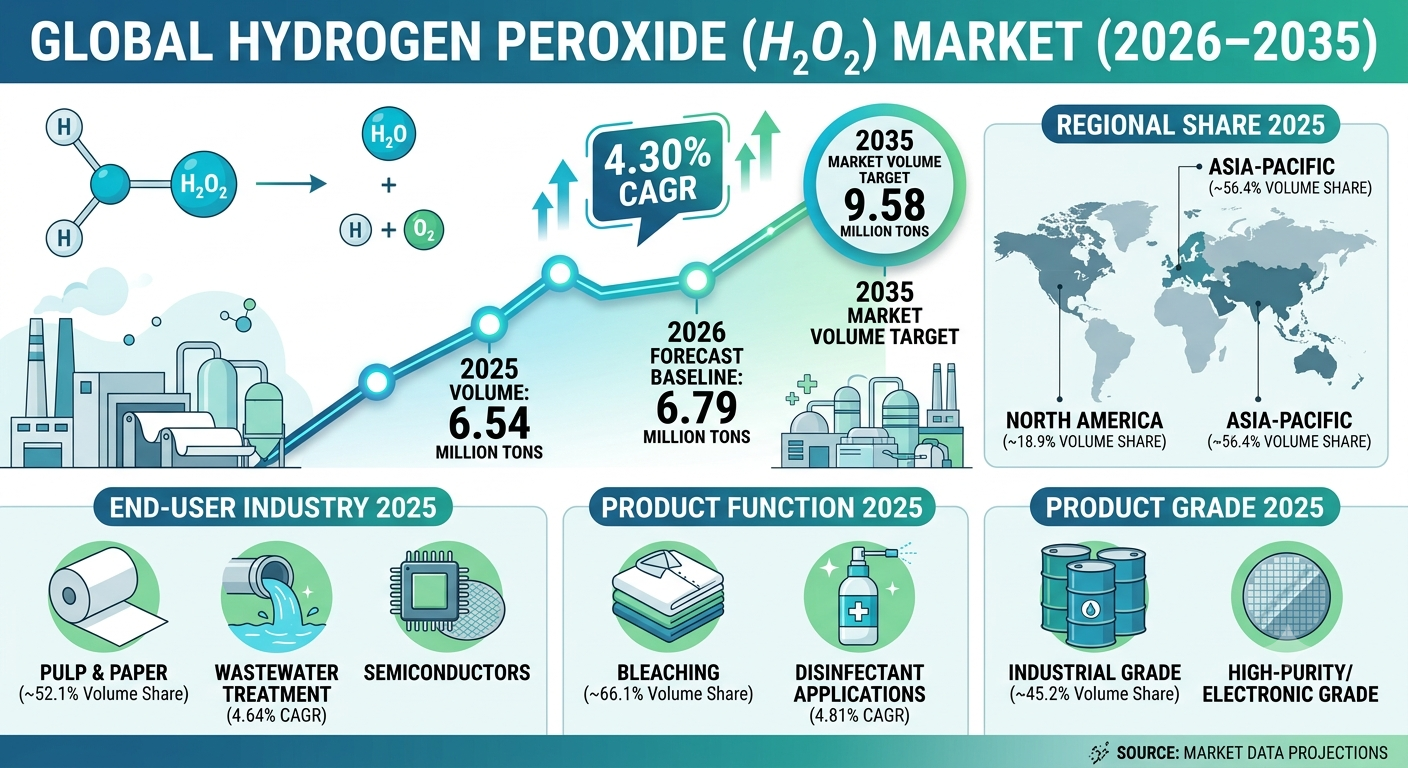
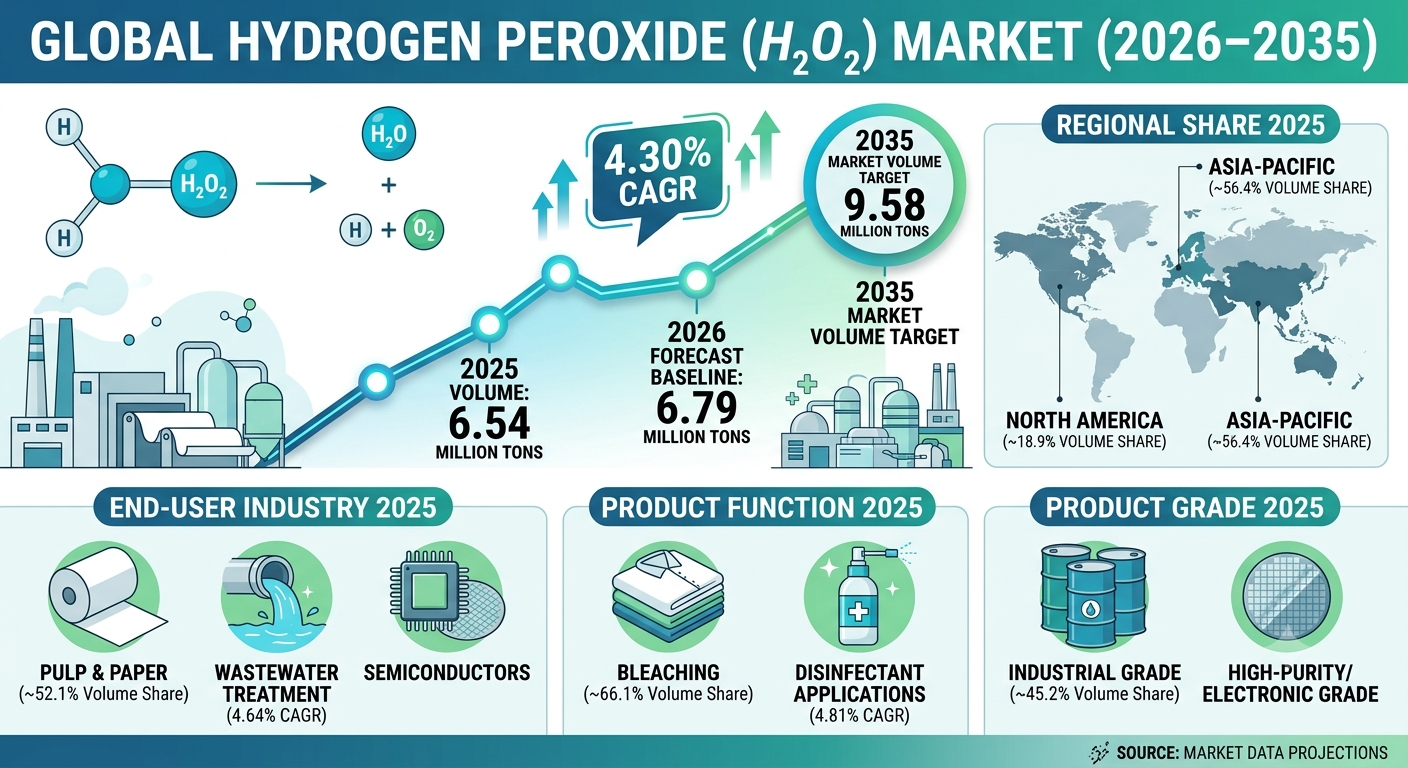
WA, UNITED STATES, August 24, 2026 /EINPresswire.com/ — The global hydrogen peroxide market is entering a period of steady, structurally supported expansion. Valued at an estimated $6.34 billion and 6.54 million tons in 2025, the market is projected to grow from $6.79 million tons in 2026 to approximately 9.58 million tons by 2035, registering a compound annual growth rate of 4.30%. This growth is being propelled by the relentless scaling of semiconductor fabrication capacity, tightening wastewater discharge standards across the European Union and Southeast Asia, and the healthcare sector’s permanent adoption of vaporized hydrogen peroxide sterilization protocols.
The Convergence of Electronics, Environment, and Healthcare
Three powerful demand vectors are reshaping the hydrogen peroxide landscape simultaneously. On the electronics front, advanced-node semiconductor manufacturing facilities operating at sub-nanometer geometries require substantially higher volumes of chemical processing agents per wafer than previous generations. Ultra-pure electronic-grade hydrogen peroxide is a non-negotiable element of the standard RCA cleaning sequence used to remove organic residues and surface contaminants. With global semiconductor fabrication investments exceeding $380 billion through 2030, this high-purity segment is capturing a technically demanding volume stream that commands significant price premiums above ordinary industrial bleaching alternatives.
On the environmental front, the recast European Union Urban Wastewater Treatment Directive introduced quaternary treatment obligations for plants serving populations above 150,000, greatly increasing regional reliance on advanced oxidation processes that use industrial-grade hydrogen peroxide as the principal reagent. Similar tightening of discharge limits across ASEAN member states is creating parallel demand channels in Asia-Pacific.
On the healthcare front, vaporized hydrogen peroxide devices have been integrated into infection-control workflows in hospitals worldwide, creating a consistent daily consumption of sterilization chemicals. The World Health Organization’s biosafety guidance highlights strict terminal cleaning procedures where VHP is the recommended automated decontamination method due to its broad-spectrum sporicidal activity and safe breakdown into residue-free water and oxygen.
Market Size and Forecast Trajectory
Market Research Future’s estimates combine bottom-up capacity utilization data from over 450 production facilities worldwide with top-down demand modeling validated against trade statistics, import and export databases, and end-user consumption surveys. Historical figures from 2021 through 2024 are based on verified shipment and production records. The market has grown steadily from its 2021 baseline and is expected to reach approximately $7.58 billion by 2028 before climbing toward the $9.58 billion endpoint in 2035.
Request Free Sample: https://www.marketresearchfuture.com/sample_request/7396
Segment Analysis by Product Function
Bleaching remains the volume backbone of the hydrogen peroxide market, capturing approximately 66.1% of volume share in 2025. Pulp mills and textile processors consume over two-thirds of global output as paper bleaching chemicals and fabric whiteners. However, this segment is growing below the market average as recycled-fiber adoption and enzymatic pretreatments compress per-ton dosage requirements.
Disinfectant applications represent the fastest-growing functional category, projected to expand at a 4.81% CAGR through 2035. This acceleration is driven by healthcare adoption of sterilization chemicals, food-contact surface sanitation mandates, and aseptic packaging sterilization requirements. Regulatory frameworks increasingly favor residue-free, eco-friendly disinfectants over chlorine alternatives, directly benefiting hydrogen peroxide’s oxygen-only decomposition profile.
Chemical synthesis generated approximately $680 million in 2025, primarily serving the hydrogen peroxide to propylene oxide process operated by BASF, Dow, and Evonik. Each HPPO plant absorbs 100,000 to 150,000 tons annually of industrial-grade chemical processing agents. Environmental remediation is growing at a 4.92% CAGR, with peroxide-driven Fenton reactions demonstrating 85 to 92% destruction efficiency for short-chain per- and polyfluoroalkyl substances precursors in contaminated groundwater. Other functions including mining oxidation and electronics cleaning contributed approximately $290 million.
Buy Now: https://www.marketresearchfuture.com/checkout?currency=one_user-USD&report_id=7396
Segment Analysis by Grade
Industrial grade hydrogen peroxide, spanning the 35% to 50% concentration range, dominates the market by revenue with a 45.2% share in 2025. This grade serves the broad middle ground between dilute household products and ultra-pure electronic material, anchoring pulp bleaching, textile processing, and water treatment applications.
High-purity grades exceeding 50% concentration and meeting electronic specifications represent the fastest-growing grade segment, advancing at a 5.74% CAGR. Semiconductor fabs specify sub-parts-per-billion metallic contamination levels, a qualification that only five global producers can consistently meet, conferring pricing power and margin resilience. Standard grades in the 3% to 35% range were valued at approximately $2.15 billion in 2025, serving general bleaching and household applications.
Segment Analysis by Concentration and Form
Aqueous solutions overwhelmingly dominate the market, capturing approximately 85.5% of volume in 2025. Liquid handling infrastructure is already installed across pulp mills, water utilities, and chemical plants, making aqueous delivery the default specification. Powder and granular adducts, including sodium percarbonate and carbamide peroxide, are the fastest-growing form category, expanding at a 4.74% CAGR. These solid formats retain over 90% active oxygen for 18 months at ambient storage versus 6 to 9 months for 35% aqueous solutions, driving adoption in consumer laundry pods and dental whitening products.
Segment Analysis by End-User Industry
Pulp and paper remains the anchor end-user industry, accounting for approximately 52.1% of market demand in 2025. Total chlorine-free and elemental chlorine-free bleaching sequences rely on hydrogen peroxide as the primary eco-friendly bleaching agent. However, closed-loop bleach filtrate recovery systems now recapture 20 to 30% of unreacted peroxide at leading Scandinavian mills, gradually compressing net consumption per ton of finished pulp.
Chemical synthesis contributed approximately $710 million in 2025, with propylene oxide production representing the dominant chemical route.
Wastewater treatment is the fastest-growing end-user segment, expanding at a 4.64% CAGR, as advanced oxidation process installations multiply under tightening discharge regulations. Mining applications were valued at approximately $280 million, serving heap-leach oxidation circuits. Textile processing is growing at a 4.38% CAGR, driven by fabric preparation and bleaching demand in India and Bangladesh. Other industries spanning food processing, electronics, and healthcare contributed approximately $410 million.
Regional Landscape: Asia-Pacific Dominates, All Regions Expand
Asia-Pacific commands the largest share of the global hydrogen peroxide market at approximately 56.4% of volume in 2025, and it remains the fastest-growing region. This dominance reflects the region’s concentration of pulp capacity, textile processing, and semiconductor fabrication. China alone captures roughly 48.6% of the regional share, operating over 300 peroxide plants with capacity additions that outpace domestic demand growth, creating export pressure that depresses commodity pricing across the region. India is expanding at a 5.12% CAGR, with its textile sector representing the fastest-growing consumer of bleaching chemicals in Asia-Pacific. Japan contributed approximately $420 million, focused on electronics and specialty peroxide compounds. South Korea is growing at a 5.38% CAGR, driven by the Yongin and Pyeongtaek semiconductor clusters. The ASEAN bloc generated approximately $530 million, serving palm oil refining and water treatment chemicals. The rest of Asia-Pacific is expanding at a 4.15% CAGR.
North America holds approximately 18.9% of global market share and is projected to reach $2.89 billion by 2035. The United States dominates with roughly 72.3% of regional revenue, benefiting from a massive wave of domestic semiconductor fabrication facility construction spurred by federal manufacturing incentives. Each newly commissioned foundry requires ultra-pure electronic-grade chemical processing agents, creating a durable demand floor. Canada is growing at a 4.68% CAGR through pulp mill modernization in British Columbia and Quebec. Mexico contributed approximately $105 million, with maquiladora textile corridors scaling hydrogen peroxide consumption to replace legacy chemistry under tighter export quality standards.
Europe accounts for roughly $1.78 billion in 2025 and is shaped by the EU Green Deal’s push for carbon-neutral chemical production and the revised Urban Wastewater Treatment Directive mandating advanced oxidation. Germany anchors the region with approximately 24.8% of European share, serving chemical synthesis and automotive catalysis. The United Kingdom is growing at a 4.39% CAGR through healthcare sterilization chemicals adoption. France contributed approximately $215 million, supported by nuclear decontamination and food processing applications. Italy is expanding at a 3.92% CAGR through textile processing chemicals demand. Spain generated approximately $125 million, focused on agricultural disinfection. The Nordic countries are growing at a 4.61% CAGR through paper bleaching chemicals and green production leadership. Russia captured roughly $140 million through mining and commodity chemical processing. The rest of Europe is expanding at a 3.78% CAGR.
South America was valued at approximately $310 million in 2025 and is expanding at a 3.85% CAGR. Brazil dominates with roughly 58.3% of the regional share, with large-scale eucalyptus pulp capacity expansions led by Suzano and Klabin driving a massive, stable demand base for industrial bleaching chemicals. Argentina is growing at a 4.02% CAGR through lithium extraction expansion across the Salta and Jujuy provinces, which is opening specialized demand pockets for industrial oxidizing agents. The rest of South America contributed approximately $85 million.
The Middle East and Africa generated approximately $310 million in 2025. Saudi Arabia leads with roughly 32.1% of regional share, with NEOM and Jubail industrial developments embedding hydrogen peroxide into advanced water treatment chemicals infrastructure for desalination brine management. The United Arab Emirates is growing at a 4.45% CAGR through healthcare and food safety applications. South Africa contributed approximately $48 million, with platinum group metals mining using peroxide-based chemical processing agents in flotation circuits. Egypt is expanding at a 3.95% CAGR through textile processing chemicals demand. The rest of the region contributed approximately $72 million.
Report Summary: https://www.marketresearchfuture.com/reports/hydrogen-peroxide-market-7396
Key Growth Drivers
Semiconductor ultra-high-purity demand contributes the largest estimated impact on the overall compound annual growth rate, adding approximately 18% of growth momentum. Advanced node fabrication facilities require extensive volumes of electronic-grade peroxide for RCA cleaning sequences, and sub-parts-per-billion purity specifications create a protected, high-margin segment.
Municipal wastewater discharge regulations contribute roughly 16%, particularly in Europe and ASEAN where quaternary treatment mandates and advanced oxidation process adoption are accelerating. Healthcare vaporized hydrogen peroxide sterilization protocols add approximately 14%, creating a stable, recurrent baseline consumption model independent of seasonal infection cycles. On-site electro-oxidation deployment contributes about 13%, as mid-tier utilities adopt localized generation to eliminate hazardous transport logistics. Low-carbon and green peroxide premiums add roughly 12%, with pulp processors and consumer goods brands paying 15 to 20% premiums for validated low-carbon product. Textile and food-grade bleaching expansion contributes approximately 15%, while mining heap-leach oxidation adoption adds about 12% over the long term.
Competitive Landscape
The hydrogen peroxide market exhibits moderate concentration, with an estimated Herfindahl-Hirschman Index between 850 and 950 and the top five producers controlling roughly 43% of global capacity. Over 400 regional plants, predominantly in China and Southeast Asia, compete on freight advantage, keeping commodity pricing under pressure. Strategic differentiation increasingly hinges on electronic-grade capability, green production credentials, and integrated on-site generation offerings.
Evonik Industries AG leads with an estimated 8 to 11% revenue share, offering standard to electronic-grade peroxide and green production technology. The company is a technology leader in HPPO process chemistry and low-carbon peroxide production. In January 2025, Evonik and Fuhua officially established a joint venture named Evonik Fuhua New Materials in Leshan, China, with Evonik holding a 51% majority stake. The partnership utilizes raw industrial-grade hydrogen peroxide from Fuhua’s mega-plant and purifies it using Evonik’s proprietary technology.
Solvay SA captures roughly 7 to 10% of the market through industrial and high-purity grades supported by an integrated upstream hydrogen and global logistics network. In June 2025, Solvay and BASF announced a strategic collaboration to lower the Scope 3 greenhouse gas footprint of hydrogen peroxide production, with Solvay restructuring its supply chain to select BASF as its primary local supplier of aluminum chloride for its Linne Herten plant in the Netherlands.
Arkema SA holds approximately 5 to 8% through organic peroxides and specialty peroxide compounds, maintaining a specialty chemicals focus with polymer initiator expertise. Nouryon, formerly AkzoNobel Specialty Chemicals, captures roughly 5 to 7% through pulp bleaching chemicals and on-site generation services, leveraging strong Nordic pulp mill relationships.
Mitsubishi Gas Chemical accounts for approximately 4 to 6% with electronic-grade and semiconductor cleaning agents, deeply integrated into the Asia-Pacific semiconductor supply chain. OCI NV holds roughly 3 to 5% as a cost-competitive producer with a Middle East production base. Kemira Oyj captures approximately 3 to 5% through water treatment chemicals and paper bleaching chemicals expertise. Hansol Chemical holds roughly 2 to 4% as a high-purity electronic-grade supplier with proximity to Korean semiconductor clusters. PeroxyChem, an Evonik subsidiary, accounts for approximately 2 to 4% through environmental remediation and chemical processing agents leadership in North America. Aditya Birla Chemicals rounds out the competitive set with roughly 2 to 3% through industrial-grade textile processing chemicals and Indian domestic market cost leadership.
Related Report
hydrogen sulphide market https://www.marketresearchfuture.com/reports/hydrogen-sulphide-market-22455
liquid hydrogen market https://www.marketresearchfuture.com/reports/liquid-hydrogen-market-24968
hydrogen sulfide scavenger market https://www.marketresearchfuture.com/reports/hydrogen-sulfide-scavenger-market-23126
electronic grade hydrogen peroxide market https://www.marketresearchfuture.com/reports/electronic-grade-hydrogen-peroxide-market-25069
hydrogen storage alloys market https://www.marketresearchfuture.com/reports/hydrogen-storage-alloys-market-39835
Market Research Future
Market Research Future
+1 855-661-4441
email us here
Legal Disclaimer:
EIN Presswire provides this news content “as is” without warranty of any kind. We do not accept any responsibility or liability
for the accuracy, content, images, videos, licenses, completeness, legality, or reliability of the information contained in this
article. If you have any complaints or copyright issues related to this article, kindly contact the author above.

Media gallery