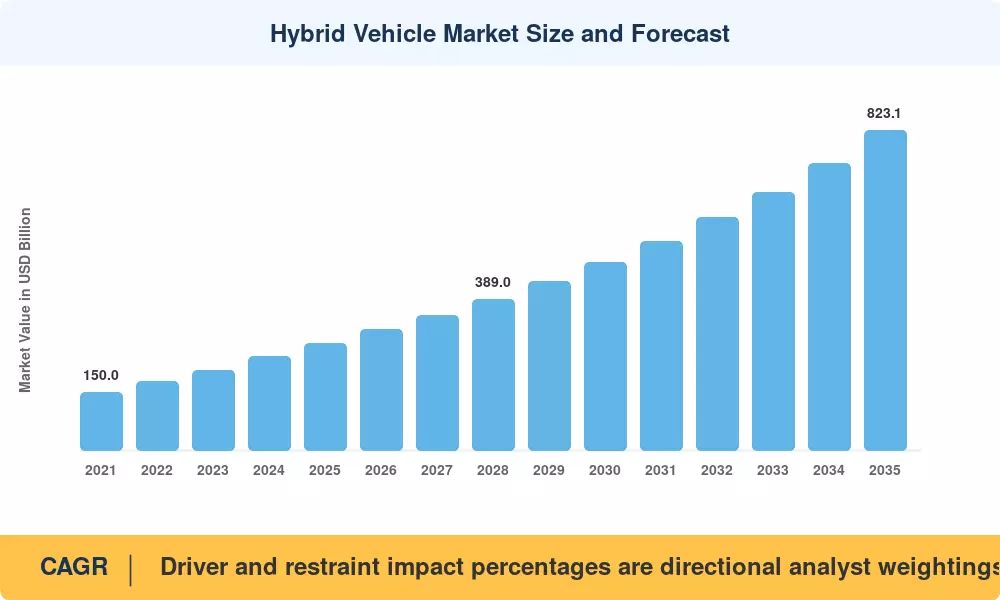
Hybrid Vehicle Market to Reach USD 823.1 Billion by 2035, Growing at 11.03% CAGR
Full hybrid (HEV) systems hold 45.5% of 2025 Hybrid Vehicle Market revenue, the largest single architecture. NEW YORK,

Press Release Disclaimer: This is a press release distributed through the XPR Media network. It has not been independently verified by our newsroom.

Full hybrid (HEV) systems hold 45.5% of 2025 Hybrid Vehicle Market revenue, the largest single architecture.
NEW YORK, NY, UNITED STATES, August 26, 2026 /EINPresswire.com/ — According to Market Research Future, the Hybrid Vehicle Market is projected to reach USD 823.1 Billion by 2035, registering a CAGR of 11.03% during the forecast period. This remarkable growth trajectory reflects the pivotal role that hybrid vehicles play in the global automotive industry’s transition toward sustainable mobility. Hybrid vehicles combine internal combustion engines with electric propulsion systems, offering consumers the benefits of reduced fuel consumption and lower emissions while eliminating range anxiety associated with fully electric vehicles. The market’s robust expansion is driven by stringent emission regulations worldwide, increasing consumer awareness of environmental issues, technological advancements in battery and powertrain systems, and the growing availability of hybrid models across all vehicle segments.
Market Overview
Hybrid vehicles represent a transformative technology in the automotive industry, integrating internal combustion engines with electric motors and battery systems to achieve superior fuel efficiency and reduced emissions compared to conventional vehicles. These vehicles utilize sophisticated hybridization technologies including full hybrids, mild hybrids, plug-in hybrids, and extended-range electric vehicles, each offering distinct advantages in terms of fuel economy, electric-only driving range, and overall performance. The hybrid vehicle market encompasses a diverse range of applications from passenger cars to light commercial vehicles and heavy commercial vehicles, catering to varied consumer needs and regulatory requirements.
The key growth drivers propelling this market forward include increasingly stringent emission regulations across major automotive markets, particularly in Europe, North America, and Asia Pacific, compelling automakers to offer hybrid solutions that meet CO2 reduction targets. Consumer demand for fuel-efficient vehicles is rising as fuel prices fluctuate and environmental consciousness grows, making hybrids an attractive option for cost-conscious and eco-aware buyers. The expanding availability of hybrid models across price segments, from entry-level to luxury vehicles, has democratized access to hybrid technology and accelerated market adoption. Additionally, government incentives including tax credits, subsidies, and access to restricted driving zones in congested cities are encouraging consumer adoption of hybrid vehicles.
The demand outlook for hybrid vehicles remains exceptionally robust, with the market projected to sustain strong growth throughout the forecast period. The increasing electrification of vehicle fleets worldwide is driving demand for hybrid systems across all vehicle categories. The commercial vehicle segment is witnessing particularly strong growth as logistics companies seek to reduce operational costs and meet sustainability targets through hybrid adoption. The expansion of charging infrastructure, particularly for plug-in hybrids, is making hybrids more practical and appealing to consumers.
📍 Get Free Sample Report for Detailed Market Insights:
https://www.marketresearchfuture.com/sample_request/6025
Market Segmentation
The hybrid vehicle market is segmented based on hybridization technology, vehicle type, drivetrain configuration, component, and regional analysis to provide comprehensive insights into industry dynamics.
By Hybridization Technology: The market is categorized into Full Hybrid, Mild Hybrid, Plug-in Hybrid, and Extended-Range Electric Vehicle segments. Full Hybrid vehicles can operate using only the internal combustion engine, only the electric motor, or a combination of both, offering flexibility in urban driving conditions where electric-only operation provides significant fuel savings. Mild Hybrid vehicles utilize a 48-volt system that provides regenerative braking and engine assist functions, offering a more cost-effective hybridization solution with modest fuel economy improvements of approximately 10-15 percent. Plug-in Hybrid Electric Vehicles feature larger battery packs that can be charged from external sources, offering substantial electric-only driving range typically between 20 and 50 miles, combining the benefits of electric vehicles with the range security of internal combustion engines. Extended-Range Electric Vehicles function primarily as electric vehicles with a small internal combustion engine serving as a generator to extend range, offering electric-only operation for daily commuting and range extension for longer journeys. The Plug-In Hybrid Electric Vehicles PHEV Market provides deeper insights into the fastest-growing hybridization segment.
By Vehicle Type: The market is divided into Passenger Cars, Light Commercial Vehicles, and Heavy Commercial Vehicles & Buses. Passenger Cars dominate the market, driven by widespread consumer adoption, extensive model availability from virtually all major automakers, and the strongest impact of regulatory incentives and emission standards. Light Commercial Vehicles represent a growing segment as fleet operators seek to reduce operating costs and meet corporate sustainability targets, with hybrid vans and delivery vehicles gaining popularity in urban areas where emission restrictions are tightening. Heavy Commercial Vehicles & Buses represent a significant opportunity, particularly in public transit applications where hybrid buses offer substantial fuel savings and emission reductions in urban environments. Hybrid technology is increasingly being deployed in heavy-duty applications to meet regulatory requirements while maintaining the performance and reliability required for commercial operations.
By Drivetrain Configuration: The market is segmented into Parallel, Power-Split, Series, and Other Configurations. Parallel hybrids allow both the internal combustion engine and electric motor to provide power to the wheels, either independently or together, offering efficiency advantages at highway speeds where the internal combustion engine operates most efficiently. Power-Split hybrids utilize planetary gear sets to seamlessly distribute power between the internal combustion engine, electric motor, and generator, offering continuous variable transmission characteristics and superior efficiency across a wide range of operating conditions. Series hybrids utilize the internal combustion engine solely as a generator to power the electric motor, offering simplified drivetrain design and optimal efficiency at lower speeds, making them particularly suitable for urban driving applications.
By Component: The market is categorized into Battery Pack, Electric Motor, Transmission & E-Axle, and Power Electronics. Battery packs are the most critical component, representing a substantial portion of total system cost and significantly influencing vehicle performance and driving range. The Hybrid EV Battery Market is closely related to overall hybrid vehicle adoption, as battery technology advancements directly impact hybrid vehicle capability and consumer appeal. Electric motors are essential for converting electrical energy to mechanical power, with continuous improvements in motor efficiency and power density enhancing overall vehicle performance. Transmission and E-Axle systems integrate electric motors into drivetrains, enabling compact packaging and efficient power delivery. Power electronics, including inverters and converters, manage the flow of electricity between the battery, motor, and generator, with advancements in power density and efficiency contributing to overall system performance.
By Region: The market covers North America, Europe, South America, Asia Pacific, and the Middle East and Africa. Asia Pacific dominates the global market, driven by massive automotive production volumes, government support for electrification, and the presence of leading hybrid vehicle manufacturers, particularly in Japan, China, and South Korea. Europe follows closely with stringent emission regulations and strong consumer preference for fuel-efficient vehicles. North America represents a mature market with steady growth driven by hybrid pickup trucks and SUVs gaining popularity among consumers seeking fuel economy without sacrificing capability.
🛒 You can buy this market report at:
https://www.marketresearchfuture.com/checkout?currency=one_user-USD&report_id=6025
Regional Analysis
Asia Pacific dominates the global hybrid vehicle market, commanding the largest share driven by massive automotive production volumes, government support for electrification, and the presence of leading hybrid vehicle manufacturers. Japan leads the region with Toyota Motor Corporation pioneering hybrid technology with its long-running and successful Prius lineup, and the country’s strong consumer acceptance of hybrid vehicles driven by fuel efficiency and environmental considerations. China represents the fastest-growing market in the region, with the Chinese government actively promoting new energy vehicles through substantial subsidies and regulatory advantages, driving rapid adoption of plug-in hybrid vehicles particularly. South Korea is witnessing robust growth with strong domestic automaker support and the government’s green vehicle initiatives encouraging hybrid adoption. The region’s expanding charging infrastructure, particularly for plug-in hybrids, is making hybrids more practical and appealing to consumers in urban areas.
Europe represents a technologically sophisticated market with strong growth driven by stringent emission regulations, government incentives, and increasing consumer preference for fuel-efficient vehicles. Germany leads the European market with major automakers expanding their hybrid portfolios to meet EU CO2 emission targets and consumer demand for premium hybrid vehicles. The United Kingdom, France, and the Nordic countries are witnessing strong hybrid adoption driven by generous tax incentives and growing environmental awareness. The European market is characterized by high consumer acceptance of plug-in hybrid technology and the expansion of public charging infrastructure supporting increased adoption. The region’s focus on reducing transportation emissions and achieving carbon neutrality targets continues to drive hybrid vehicle demand, particularly in the passenger car segment.
North America represents a significant and growing market, characterized by increasing consumer interest in hybrid technology across vehicle categories. The United States leads the region, with hybrid pickup trucks and SUVs from Ford, Toyota, and other manufacturers gaining popularity among consumers seeking fuel economy without sacrificing capability. California’s strict emission regulations serve as a catalyst for hybrid adoption, with the state’s zero-emission vehicle mandate incentivizing automakers to offer a diverse range of hybrid options. The US government’s Inflation Reduction Act provides tax credits for plug-in hybrid vehicles, boosting market demand. Canada shows strong growth with federal and provincial incentives encouraging hybrid adoption, particularly in urban centers where environmental concerns and fuel costs drive consumer choices.
South America and the Middle East and Africa represent emerging markets with growth potential for hybrid vehicles. South America, led by Brazil, is experiencing increasing interest in hybrid technology driven by fuel economy benefits in a region where fuel costs significantly impact total cost of ownership. Brazil’s flexible-fuel vehicles utilizing ethanol present a unique market dynamic where hybrid technology can offer additional efficiency benefits. The Middle East, while currently a smaller market, is showing interest in hybrid technology driven by fuel consumption concerns and growing environmental awareness, with the UAE and Saudi Arabia investing in sustainable transportation infrastructure. South Africa’s developing automotive manufacturing base and growing vehicle parc create opportunities for hybrid adoption.
Competitive Landscape and Key Players
The hybrid vehicle market is characterized by intense competition among established global automakers, with key players focusing on technological innovation, portfolio expansion, and strategic partnerships to strengthen their market positions. The market is relatively consolidated, with a mix of pioneering hybrid manufacturers and automakers aggressively expanding their hybrid offerings.
Major companies operating in this space include Toyota Motor Corporation, Honda Motor Co., Ltd., Ford Motor Company, General Motors Company, Hyundai Motor Company, Kia Corporation, BMW AG, Mercedes-Benz Group AG, Volkswagen AG, Stellantis N.V., Nissan Motor Corporation, BYD Company Limited, Geely Automobile Holdings Limited, Tesla Inc., and SAIC Motor Corporation Limited. These industry leaders invest significantly in research and development to create innovative hybrid solutions that meet evolving consumer preferences and regulatory requirements.
Strategic developments are reshaping the competitive landscape as automakers adapt to the accelerated transition toward electric mobility. Leading manufacturers are expanding their hybrid portfolios across all vehicle segments, ensuring availability of hybrid options for every model line. Strategic collaborations between automakers and battery suppliers are becoming increasingly important for securing battery supply and advancing technology development. Partnerships for platform sharing and technology licensing are enabling smaller automakers to access hybrid technology without extensive in-house development.
Latest Industry News and Developments
Recent industry developments highlight the dynamic evolution of the hybrid vehicle market and the strategic responses of key players to emerging trends. A major global automaker recently announced a significant expansion of its hybrid vehicle lineup, introducing hybrid versions across multiple model lines to meet growing consumer demand and prepare for stricter emission regulations in key markets.
Another significant development involves a leading automotive manufacturer unveiling a new generation of plug-in hybrid powertrain technology offering substantially increased electric-only driving range and improved overall efficiency. The new system features advanced battery technology and more efficient electric motors, positioning the automaker competitively in the rapidly evolving hybrid market.
In the technology innovation space, a prominent battery manufacturer announced a strategic partnership with an automaker to develop advanced battery systems specifically designed for hybrid vehicle applications. The partnership focuses on developing batteries with improved power density and cycle life, addressing the specific requirements of hybrid vehicle operation where frequent charge-discharge cycles demand exceptional durability.
Market Challenges and Opportunities
The hybrid vehicle market faces several significant challenges that require strategic responses for sustainable growth. The transition toward fully electric vehicles represents a long-term challenge to hybrid technology, as increasingly stringent zero-emission vehicle mandates in various jurisdictions may eventually phase out hybrid vehicles. The cost competitiveness of hybrid vehicles compared to conventional vehicles remains a challenge, with the additional cost of hybrid systems potentially limiting adoption in price-sensitive segments. Infrastructure development for plug-in hybrid charging continues to require significant investment, though progress is being made across major markets.
Emerging opportunities in the market are substantial and growing. The demand for fuel-efficient vehicles in markets with high fuel costs creates significant growth opportunities for hybrid technology. The commercial vehicle segment represents an expanding opportunity as fleet operators seek to reduce operating costs and meet sustainability targets through hybrid adoption. The growing availability of plug-in hybrid models with extended electric range makes these vehicles increasingly practical for consumers seeking electric driving capability without range limitations.
Technology-driven possibilities are expanding rapidly across the industry. Advances in battery technology, including higher energy density and faster charging, are expanding the capabilities and appeal of plug-in hybrids. Integration of connectivity and artificial intelligence into hybrid control systems enables more efficient operation through predictive energy management based on route and traffic conditions. Development of more efficient electric motors and power electronics continues to improve hybrid system performance while reducing cost and weight.
To explore more market insights, visit us at:
https://www.marketresearchfuture.com/reports/hybrid-vehicle-market-6025
Final Market Summary
Key factors expected to influence future development include the pace of fully electric vehicle adoption, regulatory frameworks promoting zero-emission vehicles, technological advances in battery technology and hybrid powertrains, and the evolving competitive landscape shaped by strategic partnerships and portfolio expansion. The hybrid vehicle market, while facing challenges from the industry’s gradual shift toward full electrification, continues to play an essential role in reducing emissions and improving fuel efficiency across the global vehicle fleet, serving as a critical bridge technology toward a more sustainable transportation future.
More Related Reports from MRFR Library:
Two Wheeler Tires Market : https://www.marketresearchfuture.com/reports/two-wheeler-tires-market-24465
Caravan and Motorhome Market : https://www.marketresearchfuture.com/reports/caravan-motorhome-market-24506
Cargo Van Market : https://www.marketresearchfuture.com/reports/cargo-van-market-24524
Caster Wheel Market : https://www.marketresearchfuture.com/reports/caster-wheel-market-24532
Motorcycle Battery Market : https://www.marketresearchfuture.com/reports/motorcycle-battery-market-24730
High Speed Rail Market : https://www.marketresearchfuture.com/reports/high-speed-rail-market-25123
Valet Parking Technology Market : https://www.marketresearchfuture.com/reports/valet-parking-technology-market-26306
Motorcycle Cooling Helmet Market : https://www.marketresearchfuture.com/reports/motorcycle-cooling-helmet-market-26487
Hospitality Robot Market : https://www.marketresearchfuture.com/reports/hospitality-robot-market-26539
Wheelchair Accessible Vehicle Market : https://www.marketresearchfuture.com/reports/wheelchair-accessible-vehicle-market-26650
Market Research Future
Market Research Future
+1 855-661-4441
email us here
Legal Disclaimer:
EIN Presswire provides this news content “as is” without warranty of any kind. We do not accept any responsibility or liability
for the accuracy, content, images, videos, licenses, completeness, legality, or reliability of the information contained in this
article. If you have any complaints or copyright issues related to this article, kindly contact the author above.

Media gallery